Mittwoch, 22. August 2012

Whodunnit?

In this post we are looking for culprits.

 Murder by Death (1976): A Tacky Situation

The Financial Analyst Journal of  July/August 2012 includes an interesting article about underperformance of institutional money (pension funds etc.): Murder on the Orient Express: The Mystery of Underperformance by Charles D. Ellis. He explains the mystery why institutional investors underperform their benchmark, although they are supposed to be professional and have the best experts at their disposal.
One important driver are the costs of active management: costs for an active equity mandate have risen from 0.1% to 0.5%. Fixed income mandates will be significantly lower, while alternative investment mandates considerably higher.
I have written a post about investors underperforming the mututal funds they are selecting. It is very similar here:


The clients fire underperforming managers and hire managers who have outperformed in the past, expecting the outperformance to continue. Unfortunately, past performance says nothing about future performance.

Suspect # 1: Investment Managers

Client-manager meetings are unfortunately sales meetings. Manager who had a lucky streak the past few years seek prospective clients and present them with their fabulous track record to gain new clients. No manager will admit that markets today are very efficient and competitive, and that it is hardly impossible to beat the market consistently over time. They present their performance as a product of skill rather than luck.

Suspect # 2: Investment Consultants

Institutional clients often employ investment consultants who help monitoring hired managers and help selecting new managers. Since no consultant can consistently identify the future winning and losing managers, the consultant will want to diversify into different managers. And the more managers he oversees, the more work he has and fees he can justify. The consultant will want to develop a personal service relationship by increasing the amounts of emails, phone calls etc.
Worse, as a consultant, you will not present managers whose investment style suffered in the past few year. You will want to present the investment committee the "winner", but will not tell him, that you are in no position to separate consistently winners from losers. Result: The consulting firm's client will select manager after their best years, and fire managers after their worst years.

Suspect # 3: Fund Executives

Fund executives are usually cautious processing people. But the representatives of investment managers are socially dominant people who are "skilled at closing transactions" with fund executives, called gate keepers among investment managers. Hence, fund executives will be overwhelmed by consultants and the managers sales people.

Suspect # 4: Investment Committees

The committee hires usually the the managers whose past performance was most compelling and made the most persuasive  presentation (sales skill!)
Committees' member suffer usually following handicaps:
  • They believe, it is their duty to select top managers and that past performance is a guide for future performance.
  • Bevioural finance aspects, like overreacting to recent events and neglecting long term facts (like returns reverting to the mean).
  • Listening to closely to an investment consultant, who is primarily following hits own interest.
  • Being too much hands on in fields they shouldn't meddle (like investment management decisions) and having not enough time for the important questions of the funds governance.

Conclusion

All involved parties are to blame, yet none will recognize "its own role in in the crime".

In my opinion, it is  important to keep costs in check and not choose a manager because of his fabulous short term performance. On the contrary, I have recently bought the Julius Baer Multipartner - Gold Equity Fund precisely because their recent performance (this year in USD -17.3%) was bad and knowing that the management team of this fund is very skillful. Also keep in mind, that although capital markets are efficient most of the time, but not always: In the world of efficient markets there shouldn't be any bubbles, and behavioural finance explains why humans often create market anomalies through their irrationality.


Donnerstag, 16. August 2012

Time to Buy Gold Mine Stocks


Gold mining stocks have underperformed gold and  general stocks for over a year:
Gold Mines, MSCI World and Gold, Source: Reuters
General investors have given up on goldmines. One reason is, according to Joe Frost of Van Eck, their focus on increased mining costs during the last quarters, while neglecting that the high profit margins remain high or are even increasing.

According to Walter Wehrli, Erich Meier and Marc Gugerli of Konwave AG, manager / adviser of various gold equity funds, costs have gone up due to increased energy prices, the treatment of lower grade ore (which became profitable due the higher gold price), and higher equipment costs. They expect costs to  decrease in the future.Hence, the situation is now very favorable for gold mining stocks:
  • Gold remains high due to the risks of inflation and the risk of instability of the world economy.
  • General investors have abandoned gold stocks, but they are expected to buy mines as the quotes move higher from the lows of May 2012. Low M&A activity also points to a market low.
  • Mines are valued favorably with low PEs, nice dividend yields, and deliver growth opportunities.
  • Gold miners have lower debt on their balance sheets and are more cautious with new capex programs, decreasing the risk of unsuccessful investments.

Mittwoch, 18. Juli 2012

Six Countries with Negative Yields

FT listed six countries with negative yields on government bonds:
For Swiss, Danish, German, Austrian, Dutch and Finnish government bonds investors have to pay interest in order to invest in their 2 year government bonds. Also, the yields in France and Belgium are barely in positive territory.
Investors are eager to pay for safe havens as an alternative for money on (unsafe) bank accounts.

Freitag, 18. Mai 2012

The two factors weighing on markets

Financial markets have been determined by the "risk on or off" argument for 4 years. Fundamental market analysis does not count in this environment. Last year the meltdown in stock prices was caused by a deterioration of the Euro crisis and was saved in autumn by massive liquidity injection of the ECB (twice € 500bn). This summer we have even two potential areas of infection:

  1. The situation in Greece might trigger contagion. Equity markets already have discounted a deterioration in Greece.
  2. Some people think that Israel might attack Iran soon. Reuters published an article today. The article states, that Bibi is determined and the window of opportunity is closing fast. Furthermore, experts have problems to read the Israeli signals properly.
Since March, we have been in a situation of great uncertainty. And markets hate uncertainty. However,
should it be clear that those scenarios are false, markets will rally. Should one of the two worst case scenario come true, markets will dive. In the meantime they are volatile and under pressure.


Dienstag, 3. April 2012

BCA: Not much growth in the US and elsewhere

BCA just came out with their monthly forecast for April 2012:
  • US economy will not grow strongly (contrary to market perception). Although the housing market has bottomed, lacking household income growth, looming fiscal restraint, and rising gas prices will dampen growth. As a consequence...

    In the long term inflation will pick up if the economy is getting stronger and the Fed is missing the exit point. Also, the number of experts who think that a bit of inflation would be helpful to get public debt down is increasing!
  •  Eurozone: Portugal may be next in the Euro crisis. But Spain's banks are heavily engaged in Portugal, which allows the crisis to affect the whole Iberian peninsula. It is not difficult to see the crisis spreading further to Italy and then France.
    The ECB will be forced to keep interest rates very low for the next 3 to 5 years, which is supportive for the Dollar and Gold.
  • China: Although housing is continuing to weaken, BCA thinks that the economy will land softly. Mainly because Chinese homeowner are not leveraged (mortgage loans are 15% of GDP compared to 64% in the US). Hong Kong experienced a huge housing bust in the 90s without taking its economy down.


    Also the government would inject capital into their state owned banks if necessary.
  • Equities: Although the equity risk premium is very high, which suggest that equities are under valued....

    this is only true in relation to bonds, which are super expensive, yielding historic low. So don't expect a bull market.
  • Bonds: Yields will stay low for the next 2-3 years.

Profit Margins: What Goes Up, Must Come Down!

Profit margins may get squeezed by austerity

US asst manager GMO published a commentary about historically high profit margins by Charles Montier titled "What Goes Up, Must Come Down" and explains some interesting details:
  • Profit margins are on historical highs (and Wall Street analysts still forecast increasing margins)


  • Driver of the surge in profit margins were a combination of strong demand due to high government spending which and of decreased costs due to lower wages (globalization and outsourcing).
 
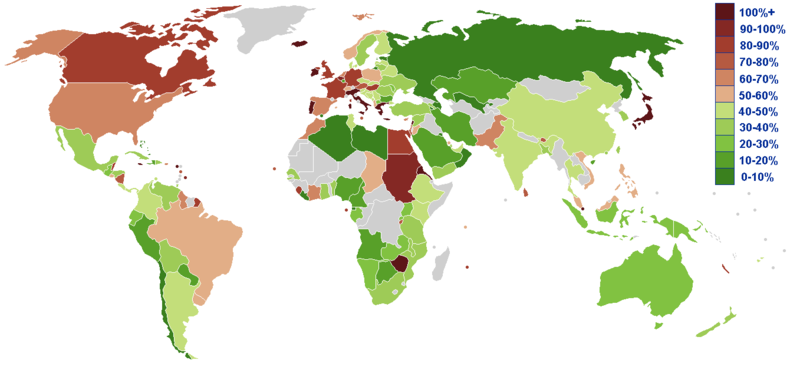
Public debt world map from Wikipedia
In many developed countries, public debt is sky high. Wikipedia has a nice list of every countries public debt.

Conclusion
In the medium term, we are stepping towards fiscal consolidation, since public debt levels are not sustainable in the long run. Hence, we have to expect that profit margins will revert to the mean (as they always did). That will spell a huge disappointment for stock holders!