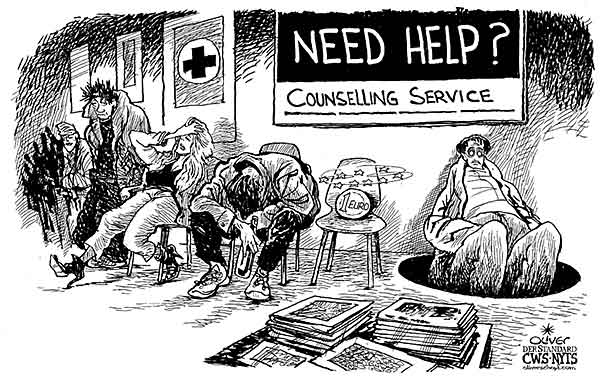
Usually you only hear leaders repeating the mantra that the Euro is safe. A ultra bearish blogger/website theeconomiccollapseblog.com has made the effort to collect
quotes from leaders stating the opposite:
#1 Polish finance minister Jacek Rostowski: "European elites, including German elites, must decide if they want the euro to survive - even at a high price - or not. If not, we should prepare for a controlled dismantling of the currency zone."
#2 Stephane Deo, Paul Donovan, and Larry Hatheway of Swiss banking giant UBS:
"Under the current structure and with the current membership, the euro does not work. Either the current structure will have to change, or the current membership will have to change."
#3 EU President Herman Van Rompuy: "The euro has never had the infrastructure that it requires."
#4 German President Christian Wulff: "I regard the huge buy-up of bonds of individual states by the ECB as legally and politically questionable. Article 123 of the Treaty on the EU’s workings prohibits the ECB from directly purchasing debt instruments, in order to safeguard the central bank’s independence"
#5 Deutsche Bank CEO Josef Ackerman: "It is an open secret that numerous European banks would not survive having to revalue sovereign debt held on the banking book at market levels."
#6 ECB President Jean-Claude Trichet: "We are experiencing very demanding times"
#7 International Monetary Fund Managing Director Christine Lagarde: "Developments this summer have indicated we are in a dangerous new phase"
#8 Prince Hermann Otto zu Solms-Hohensolms-Lich, the Bundestag's Deputy President: "We must consider whether it would not be better for the currency union and for Greece itself to go for debt restructuring and an exit from the euro"
#9 Alastair Newton, a strategist for Nomura Securities in London: "We believe that we are just about to enter a critical period for the eurozone and that the threat of some sort of break-up between now and year-end is greater than it has been at any time since the start of the crisis"
#10 Former German Chancellor Gerhard Schroeder: "The current crisis makes it relentlessly clear that we cannot have a common currency zone without a common fiscal, economic and social policy"
#11 Bank of England Governor Mervyn King: "Dealing with a banking crisis was difficult enough, but at least there were public-sector balance sheets on to which the problems could be moved. Once you move into sovereign debt, there is no answer; there's no backstop."
#12 George Soros: "We are on the verge of an economic collapse which starts, let's say, in Greece. The financial system remains extremely vulnerable."
#13 German Chancellor Angela Merkel: "The current crisis facing the euro is the biggest test Europe has faced for decades, even since the Treaty of Rome was signed in 1957."
#14 Stephane Deo, Paul Donovan, and Larry Hatheway of Swiss banking giant UBS: "Member states would be economically better off if they had never joined. European monetary union was generally mis-sold to the population of the Europe."
#15 Professor Giacomo Vaciago of Milan's Catholic University: "It's clear that the euro has virtually failed over the last ten years, even if you are not supposed to say that."
#16 EU President Herman Van Rompuy: "We’re in a survival crisis. We all have to work together in order to survive with the euro zone, because if we don’t survive with the euro zone we will not survive with the European Union."
#17 German Chancellor Angela Merkel: "If the euro fails, then Europe fails."
#18 Deutsche Bank CEO Josef Ackerman: "All this reminds one of the autumn of 2008"
#19 International Monetary Fund Managing Director Christine Lagarde: "There has been a clear crisis of confidence that has seriously aggravated the situation. Measures need to be taken to ensure that this vicious circle is broken"
#20 German Chancellor Angela Merkel: "The Euro is in danger ... If we don't deal with this danger, then the consequences for us in Europe are incalculable."
Most of the individuals quoted above desperately want to save the Euro. They are not going to go down without a fight. The overwhelming consensus among the political and financial elite in Europe is that increased European integration in Europe is the answer.
For example, EU President Herman Van Rompuy
is very clear about what he believes the final result of this crisis will be....